


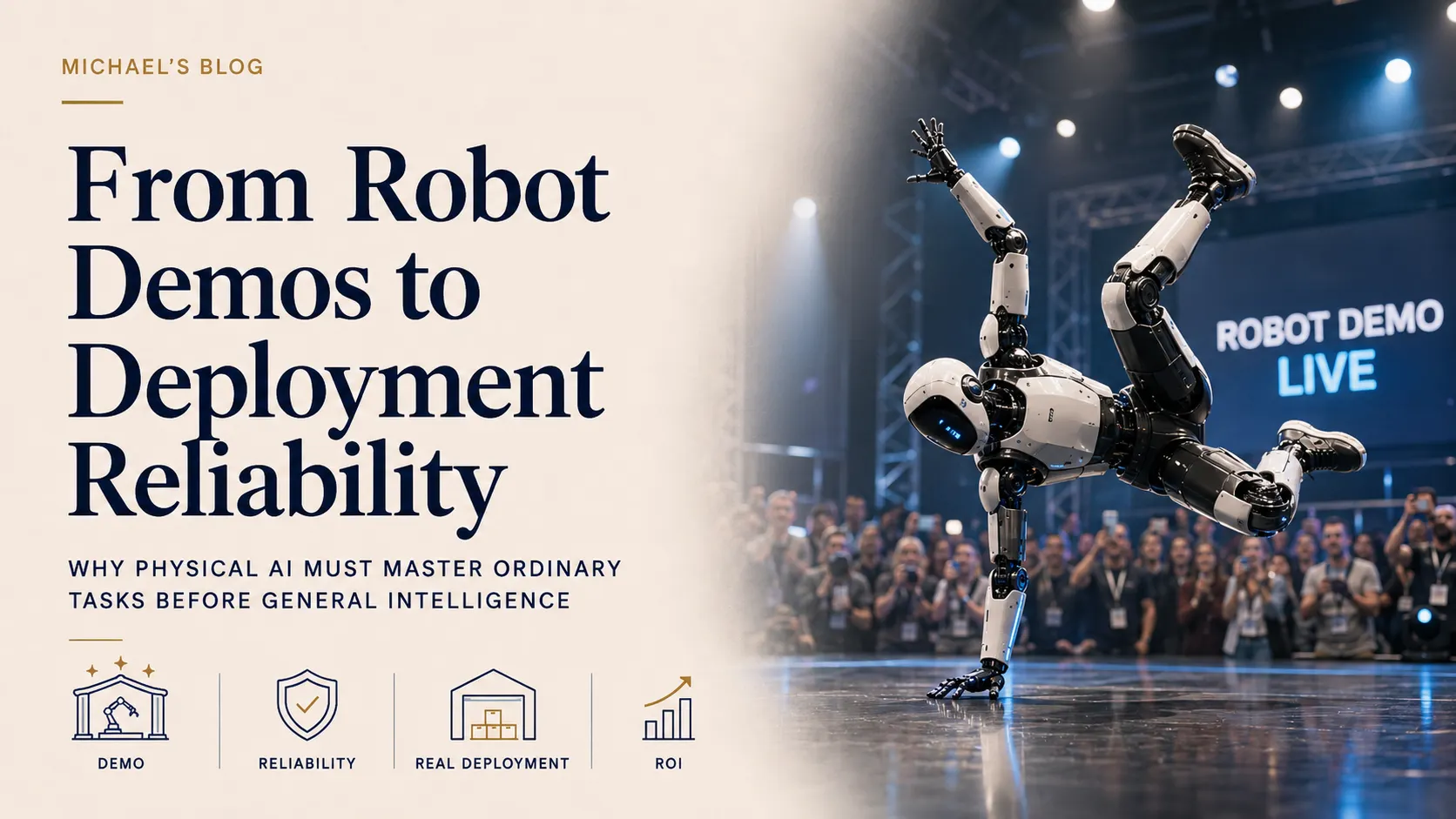
Why Physical AI Must Master Ordinary Tasks Before General Intelligence
A robot demo proves possibility. Deployment proves value.
Robotics has never lacked imagination. Every few months, a new demo captures public attention: a humanoid robot walking across uneven ground, a dexterous hand manipulating objects, a mobile robot navigating a crowded space, or a system that appears to understand natural language instructions and act on them.
These demonstrations matter. They expand our sense of what is technically possible and help the market understand that Physical AI is moving from research labs toward real-world applications.
But there is a dangerous gap between a successful demo and a reliable deployment. A demo shows that a robot can do something once, under a controlled setup, with a prepared task and often with human support behind the scenes. Deployment asks a much harder question: can the robot perform the task repeatedly, safely, economically, and with enough tolerance for real-world variation?
This is where Moravec’s paradox becomes especially relevant. It reminds us that the physical tasks humans consider simple are often the hardest for machines. And in commercial robotics, those simple tasks are exactly where real value is created.
1. The Demo-Deployment Gap
The history of AI has often been shaped by impressive benchmarks. In digital AI, progress is easy to show: a model writes code, answers questions, generates an image, or solves a reasoning task. The output can be evaluated quickly, copied cheaply, and improved through massive online data and feedback loops.
Physical AI is different. A robot must not only produce an answer. It must act in the world. Its output is not a sentence or an image, but a physical consequence.
A robotic arm that misses a grasp can drop an object. A service robot that misjudges a human’s movement can create a safety risk. A warehouse robot that fails to recover from a blocked path can slow down an entire operation. A cleaning robot that cannot handle edge cases may require so much supervision that the business case disappears.
This is why the transition from demo to deployment is so difficult. Demonstrations often optimize for visibility. Deployments optimize for reliability.
The most important question for Physical AI is therefore not simply whether a robot can perform a task. It is whether the robot can make that task economically useful in a real operating environment.
2. Moravec’s Paradox in Commercial Robotics
Moravec’s paradox tells us that tasks requiring high-level symbolic reasoning may be easier for computers than the low-level perception and motor skills that humans acquired through long evolutionary development.
In commercial robotics, this paradox appears everywhere. A robot may be able to receive a natural language instruction, recognize an object category, or plan a sequence of steps. Yet it can still fail at the physical details that humans barely notice: the object is slightly rotated, the surface is reflective, the lighting has changed, a person walks into the workspace, the object is soft or slippery, or the first attempt creates a small disturbance that changes the state of the scene.
The market does not pay for abstract intelligence in isolation. It pays for dependable operational capability. This is why a robot that can reliably perform a narrow, ordinary task may be more commercially valuable than a robot that appears more general but cannot be trusted in production.
In Physical AI, the ordinary task is not the low-value task. It is often the highest-friction task hiding in plain sight.
3. Why Customers Pay for Reliability, Not Intelligence Theater
Commercial customers usually do not buy robots because they are impressed by autonomy as a concept. They buy robots to solve specific operational problems.
A logistics operator cares about throughput, labor availability, accuracy, downtime, and safety. A retailer cares about shelf availability, inventory accuracy, customer disruption, and cost per store. A hospital cares about reliability, hygiene, traceability, safety around patients, and staff workload. A factory cares about cycle time, quality consistency, equipment integration, and risk control.
Across these industries, the value proposition is practical. A robot must answer questions such as:
- Does it reduce labor cost or help scarce labor focus on higher-value tasks?
- Does it improve throughput or service consistency?
- Does it reduce error rates or operational risk?
- Can it work safely around people, objects, and infrastructure?
- Can it run long enough without constant human intervention?
- Can it recover from common failures instead of simply stopping?
- Can it be deployed, maintained, and scaled at an acceptable total cost?
These questions are less glamorous than a viral robot video, but they define the path from technology demonstration to business value.
This also means that the competitive advantage of Physical AI will increasingly depend on deployment reliability: the ability to perform useful physical tasks under real constraints, with predictable performance and manageable risk.
4. The Hidden Complexity of Ordinary Work
Consider a few everyday commercial tasks that look simple from a distance.
Retail shelf replenishment
A robot asked to replenish shelves must recognize products, estimate available shelf space, handle different package shapes, avoid customers, adapt to inconsistent item placement, and place objects without damaging packaging. A small change in product orientation or shelf layout may require a different grasp or motion path.
Restaurant back-of-house organization
A robot helping in a kitchen or service area must handle wet surfaces, irregular objects, glassware, heat sources, human coworkers, narrow passages, and rapidly changing task priorities. The task is not just picking up objects. It is operating safely in a dynamic human environment.
Airport cleaning and inspection
A robot in an airport faces changing lighting, crowds, moving luggage, floor surface variation, restricted zones, and safety requirements. A cleaning or inspection task requires navigation, perception, obstacle avoidance, and the ability to distinguish meaningful anomalies from normal environmental variation.
Hospital logistics
A hospital robot transporting supplies must navigate human traffic, elevators, doors, infection-control rules, urgent interruptions, and high expectations for reliability. Failure is not just an inconvenience; it can affect clinical workflows.
Each of these examples looks operationally ordinary. Yet each contains the core difficulties highlighted by Moravec’s paradox: perception, motion, manipulation, contact, adaptation, and safety in an uncertain world.
5. A Practical Framework: Perceive, Act, Adapt, Recover
One useful way to think about deployment reliability is through four linked capabilities.
Many demos focus on the first two capabilities: perception and action. Commercial deployment depends heavily on the last two: adaptation and recovery.
This is where real-world data becomes critical. A robot cannot become reliable only by seeing perfect success cases. It must learn from variations, near failures, corrections, recovery behaviors, and the subtle signals that indicate when a task is about to go wrong.
A system that can recover from routine edge cases is often more valuable than a system that performs beautifully in ideal conditions but fails silently when the environment changes.
6. From Task Success to Operational Success
A single successful task execution is not the same as operational success. In a commercial setting, value emerges from repeated performance over time.
For example, a warehouse robot that succeeds in 90% of pick-and-place attempts may look impressive in a controlled evaluation. But if the remaining 10% require human intervention, the labor savings may disappear. A service robot that works well during quiet hours may still fail if it cannot handle peak traffic. A cleaning robot that navigates most spaces may still be uneconomical if it frequently gets stuck in predictable long-tail scenarios.
Physical AI therefore needs a different performance mindset. Instead of focusing only on best-case capability, the industry must measure:
- Success rate across realistic variation, not only standardized tasks;
- Mean time between interventions, not only task completion;
- Recovery rate after failure, not only initial execution;
- Safety margin in crowded or uncertain environments;
- Total cost of deployment, supervision, and maintenance;
- Performance stability across sites, shifts, objects, and operators.
This is where the business reality becomes unforgiving. Customers do not experience autonomy as a technical claim. They experience it as fewer interruptions, fewer errors, less supervision, and better economics.
7. What This Means for Robot Companies
For robotics companies, Moravec’s paradox suggests a strategic discipline: start with tasks that are commercially meaningful, physically challenging, and operationally bounded.
The best early deployment opportunities may not be the most general or futuristic. They may be repetitive, high-frequency tasks in semi-structured environments where the cost of human labor is clear and the value of automation can be measured.
This does not mean avoiding ambitious robotics. It means building a path to ambition through real deployment loops. Narrow tasks can generate valuable data, reveal long-tail failure modes, and create the operational feedback needed to improve broader capabilities.
A practical deployment strategy should therefore prioritize:
- A clearly defined task with measurable ROI;
- A constrained environment that still contains meaningful real-world variation;
- A data loop from deployment back into training and evaluation;
- Explicit failure and recovery taxonomies;
- A roadmap from narrow reliability to broader task generalization.
8. What This Means for Physical AI Data Strategy
The same logic applies to data. If the commercial bottleneck is deployment reliability, then the most valuable datasets are not just collections of clean demonstrations. They are structured records of how physical tasks unfold in real environments.
High-value Physical AI data should capture more than what happened. It should capture how the task progressed, where uncertainty appeared, how the actor adjusted, when contact occurred, what changed in the object state, and how the system recovered from imperfect execution.
This shifts the role of data from simple observation to task dynamics. The goal is not only to train perception, but to support embodied decision-making, manipulation, adaptation, and evaluation.
For data providers, the opportunity is to move beyond generic video datasets and toward domain-specific task episodes that reflect real commercial operations.
9. The Real Milestone for Physical AI
The next milestone of Physical AI is not a robot that can impress us once. It is a robot that can earn trust through repeated performance.
That trust will not come from intelligence theater. It will come from reliable action: the ability to perceive, act, adapt, and recover in the messy physical world.
Moravec’s paradox helps us see why this is so hard. It also helps us see where the opportunity lies. The largest commercial value may not begin with robots doing the most spectacular tasks. It may begin with robots mastering ordinary tasks that humans perform effortlessly, and businesses need done every day.
The next milestone of Physical AI is not a more spectacular robot demo, but a robot that can reliably perform ordinary tasks in extraordinary real-world complexity.
#PhysicalAI
#Robotics
#ArtificialIntelligence
#EmbodiedAI
#RobotLearning
